




wafer check valve Material Science Manufacturing
Introduction
Wafer check valves are critical components in fluid handling systems, designed to prevent backflow in pipelines. Positioned within the industrial chain between pump discharge and downstream process equipment, they are fundamental to maintaining system integrity and efficiency. Unlike swing or ball check valves, wafer check valves are designed for mounting between two flanged connections without the need for separate valve bodies, reducing installation space and cost. Their primary performance characteristic lies in minimizing pressure drop while ensuring reliable, automatic shut-off to prevent reverse fluid flow. The selection of appropriate materials and designs is crucial to address specific fluid compatibility, temperature, and pressure requirements. Core industry pain points include ensuring minimal leakage, resistance to corrosion and erosion, and compliance with stringent safety regulations, particularly in industries like chemical processing, water treatment, and oil & gas.
Material Science & Manufacturing
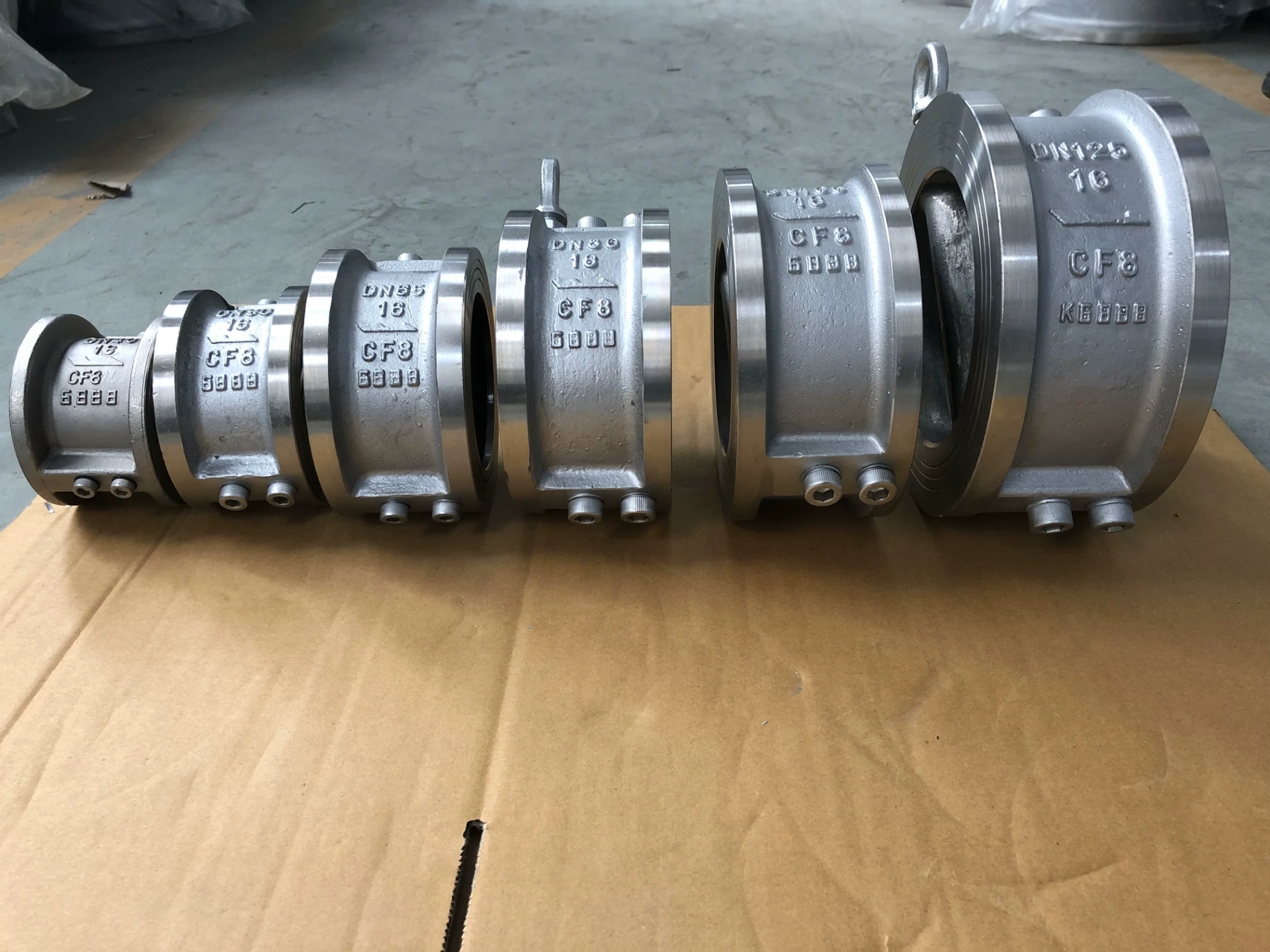
Wafer check valves commonly utilize materials such as stainless steel (304, 316, Duplex), carbon steel with epoxy coatings, and engineered polymers (PTFE, PEEK) for the disc and body construction. Stainless steels offer excellent corrosion resistance but can be susceptible to pitting corrosion in chloride-rich environments. Carbon steel, while cost-effective, requires protective coatings to mitigate corrosion. PTFE provides excellent chemical inertness but has limited mechanical strength and temperature resistance. The manufacturing process typically begins with precision casting or forging of the valve body. The disc is often manufactured using investment casting or machining from solid stock. Critical parameters include maintaining dimensional accuracy of the disc seat contact surface (typically within ±0.025mm) to ensure a tight seal. Welding procedures (SMAW, GTAW) for stainless steel components must adhere to ASME Section IX standards to guarantee weld integrity and prevent porosity or cracking. Post-welding heat treatment is often employed to relieve residual stresses and enhance corrosion resistance. Epoxy coating application involves multi-layer spraying and curing, with thickness control essential (typically 250-500 microns) to prevent coating defects and ensure adequate protection. Polymer components are produced via injection molding, where precise temperature and pressure control during the molding cycle is vital to avoid warping or internal stresses.
Performance & Engineering
The performance of a wafer check valve is heavily reliant on fluid dynamics and stress analysis. Force analysis focuses on the impact forces exerted by the fluid on the disc during closure, requiring robust disc and seat design to withstand those forces without deformation or damage. The disc’s hinge mechanism is subject to fatigue loading from repeated opening and closing cycles; finite element analysis (FEA) is employed to optimize the hinge geometry and material selection to maximize fatigue life. Environmental resistance is crucial; valves operating in high-temperature environments require materials with sufficient creep resistance and thermal expansion compatibility. Compliance with industry standards such as API 598 (Valve Inspection and Testing) dictates stringent leakage testing requirements (typically Class VI – bubble-tight shutoff). Functional implementation includes consideration of flow coefficients (Cv) to minimize pressure drop, particularly in high-flow applications. The spring mechanism, often used in spring-loaded wafer check valves, requires precise force calibration to ensure reliable closure at low flow rates and prevent premature opening due to water hammer or pressure surges. The valve’s seat geometry is engineered to create a labyrinthine seal, minimizing turbulence and improving sealing efficiency.
Technical Specifications
| Parameter | Units | Standard Specification (e.g., ASTM A351 Grade CF8M) | Typical Range |
|---|---|---|---|
| Maximum Operating Pressure | psi | ASME B16.34 | Up to 2500 |
| Operating Temperature | °F | ASTM A193 Grade B8M | -20 to 450 |
| Connection Standard | - | ASME B16.5 | 150#, 300# |
| Leakage Rate | mL/min | API 598 Class VI | 0.1 or less |
| Materials of Construction (Body) | - | ASTM A351 Grade CF8M, A536 Type 65-45 | Stainless Steel 304/316, Carbon Steel |
| Materials of Construction (Disc) | - | ASTM A276 Type 316 | Stainless Steel 316, PTFE |
Failure Mode & Maintenance
Wafer check valves are susceptible to several failure modes. Fatigue cracking of the disc or hinge mechanism can occur due to repeated cyclic loading, particularly in pulsating flow applications. Corrosion, especially pitting and crevice corrosion in chloride environments, can lead to body and disc degradation, compromising sealing integrity. Erosion, caused by abrasive particles in the fluid stream, can damage the disc and seat surfaces, increasing leakage. Delamination of epoxy coatings on carbon steel bodies exposes the underlying metal to corrosion. Seat deformation or damage, often caused by solid particle impingement or excessive pressure, results in leakage. Maintenance involves regular inspection for signs of corrosion, erosion, or coating defects. Periodic testing of leakage rates is crucial. Preventative maintenance includes lubricating the hinge mechanism (if applicable) and cleaning the valve body to remove debris. In cases of significant corrosion or erosion, complete valve replacement is often necessary. Proper installation, ensuring correct orientation and adequate support, is vital to prevent stress concentrations and premature failure. Periodic backwash operations in systems with suspended solids can help minimize erosion damage.
Industry FAQ
Q: What is the impact of flow velocity on the performance and lifespan of a wafer check valve?
A: High flow velocities can accelerate erosion of the disc and seat, reducing sealing efficiency and lifespan. Additionally, excessive velocity can induce water hammer, creating impact forces that stress the disc and hinge mechanism. Selecting a valve with appropriate flow coefficient (Cv) and implementing flow control measures are crucial to mitigate these effects.
Q: How do different seat materials affect the suitability of a wafer check valve for various fluid applications?
A: Different seat materials offer varying levels of chemical resistance. PTFE is excellent for corrosive fluids but has limited temperature resistance. Elastomeric seats (e.g., EPDM, Viton) provide good sealing but are susceptible to swelling or degradation in certain chemical environments. Metal seats (e.g., stainless steel) offer high temperature and pressure resistance but may not achieve a bubble-tight seal in all applications.
Q: What are the considerations for selecting a wafer check valve for high-temperature applications?
A: High-temperature applications require materials with adequate creep resistance and thermal expansion compatibility. Stainless steels like 316L and Duplex are often preferred. Seat materials must maintain their sealing properties at elevated temperatures. The valve design should minimize thermal stresses to prevent warping or deformation.
Q: Can wafer check valves be used with fluids containing solid particles, and if so, what precautions should be taken?
A: Wafer check valves can be used with fluids containing solid particles, but it significantly increases the risk of erosion and seat damage. Implementing filtration upstream of the valve is crucial. Selecting a valve with a hardened disc and seat material is also recommended. Regular inspection and maintenance are essential to identify and address erosion damage promptly.
Q: What is the role of spring-loaded mechanisms in wafer check valves, and what are their limitations?
A: Spring-loaded mechanisms ensure rapid closure at low flow rates and help prevent backflow due to water hammer. However, the spring can fatigue over time, reducing its effectiveness. Additionally, the spring force must be carefully calibrated to avoid premature opening or excessive closing forces, which can damage the disc or seat.
Conclusion
Wafer check valves represent a versatile and cost-effective solution for backflow prevention in diverse industrial applications. Their optimal performance hinges on a meticulous selection of materials commensurate with the specific fluid characteristics, operating temperature, and pressure conditions. Understanding the potential failure modes – encompassing fatigue, corrosion, erosion, and seat degradation – is paramount for implementing effective preventative maintenance strategies and ensuring long-term operational reliability.
Continued advancements in materials science and manufacturing processes are driving the development of wafer check valves with enhanced durability, improved sealing performance, and increased resistance to harsh operating environments. Future trends include the integration of smart technologies for remote monitoring of valve health and predictive maintenance, further optimizing operational efficiency and minimizing downtime. Adherence to relevant international standards is critical for ensuring product quality, safety, and compliance.
-
Top Reasons to Choose a Stainless Steel Flange Check Valve for Industrial Applications
-
flange 8 inch Performance Analysis
-
Ring Flange Performance Analysis
-
3 inch split flange Performance Analysis
-
Tongue and groove flange Performance Analysis
-
Grooved Flange Performance Analysis
-
o ring flange Performance Analysis
-
Ring Flanges Performance Analysis
-
Groove Flange Performance Analysis
-
Tongue and groove flanges Performance Analysis
-
12 inch flange Performance Analysis
-
Header Exhaust Flange Material Science
-
Header Exhaust Flanges Performance Analysis
-
Spacer Ring Flanges Material Science Manufacturing
-
tee flange Performance Analysis
 Afrikaans
 Albanian
 Amharic
 Arabic
 Armenian
 Azerbaijani
 Basque
 Belarusian
 Bengali
 Bosnian
 Bulgarian
 Catalan
 Cebuano
 Corsican
 Croatian
 Czech
Czech
 Danish
 Dutch
Dutch
 Esperanto
 Estonian
 Finnish
 French
 Frisian
 Galician
 Georgian
 German
 Greek
Greek
 Gujarati
 Haitian Creole
 Hausa
Hawaiian
Hausa
Hawaiian
 Hebrew
 Hindi
Hindi
 Miao
Miao
 Hungarian
 Icelandic
 Igbo
Igbo
 Indonesian
 Irish
Irish
 Italian
 Japanese
 Javanese
Kannada
Javanese
Kannada
 Kazakh
 Khmer
Khmer
 Rwandese
 Korean
 Kurdish
 Kyrgyz
 Lao
Lao
 Latin
Latin
 Latvian
 Lithuanian
 Luxembourgish
 Macedonian
 Malgashi
 Malay
Malay
 Malayalam
 Maltese
 Maori
Maori
 Marathi
 Mongolian
 Myanmar
 Nepali
 Norwegian
 Norwegian
 Occitan
 Pashto
 Persian
 Polish
 Portuguese
Punjabi
Portuguese
Punjabi
 Romanian
 Russian
 Samoan
 Scottish Gaelic
 Serbian
 Sesotho
 Shona
Shona
 Sindhi
 Sinhala
 Slovak
 Slovenian
 Somali
 Spanish
 Sundanese
 Swahili
 Swedish
Tagalog
Swedish
Tagalog
 Tajik
Tajik
 Tamil
Tamil
 Tatar
Tatar
 Telugu
 Thai
Thai
 Turkish
 Turkmen
 Ukrainian
 Urdu
Urdu
 Uighur
 Uzbek
Uzbek
 Vietnamese
 Welsh
Welsh
 Bantu
Bantu
 Yiddish
 Yoruba
 Zulu
Zulu
 English