




flanged check valves Performance Analysis

Introduction
Flanged check valves are critical components in industrial piping systems, designed to prevent backflow of fluids. Positioned within the broader valve technology landscape—which includes gate, globe, ball, and butterfly valves—check valves uniquely operate passively, relying on the pressure of the process fluid to open and close. Their function is fundamental to maintaining system integrity, preventing contamination, and safeguarding equipment from damage. Specifically, flanged check valves utilize a flanged connection to the piping system, offering a robust and reliable seal suitable for high-pressure and high-temperature applications. Their robust construction differentiates them from other check valve types like swing check valves or lift check valves, particularly in demanding industrial sectors such as oil and gas, chemical processing, and power generation. Core performance metrics include flow coefficient (Cv), pressure drop, and leak tightness, all directly influencing system efficiency and safety.
Material Science & Manufacturing
The body of a flanged check valve is commonly manufactured from carbon steel (ASTM A105), stainless steel (304, 316, Duplex), or alloy steels (e.g., A182 F304, F316). Carbon steel provides cost-effectiveness and strength for many applications, but its susceptibility to corrosion necessitates protective coatings like epoxy or galvanization. Stainless steel, particularly 316, offers superior corrosion resistance, crucial in handling aggressive chemicals or saltwater environments. Duplex stainless steel combines high strength with exceptional corrosion resistance, suitable for highly corrosive applications. The disc, critical for sealing, utilizes materials like PTFE, EPDM, Nitrile, or the same material as the body, depending on the fluid compatibility requirements. Manufacturing processes typically begin with forging or casting for the body, followed by precision machining to achieve accurate dimensions and smooth sealing surfaces. Flange faces are machined according to ASME B16.5 standards (Raised Face, Flat Face, Ring Type Joint). Welding processes (SMAW, GTAW, GMAW) are employed for joining components, with stringent quality control measures, including radiographic testing (RT), ultrasonic testing (UT), and liquid penetrant inspection (LPI), to ensure weld integrity. The internal components, such as the disc and hinge mechanism, are often manufactured via investment casting or CNC machining to achieve tight tolerances and optimal performance.
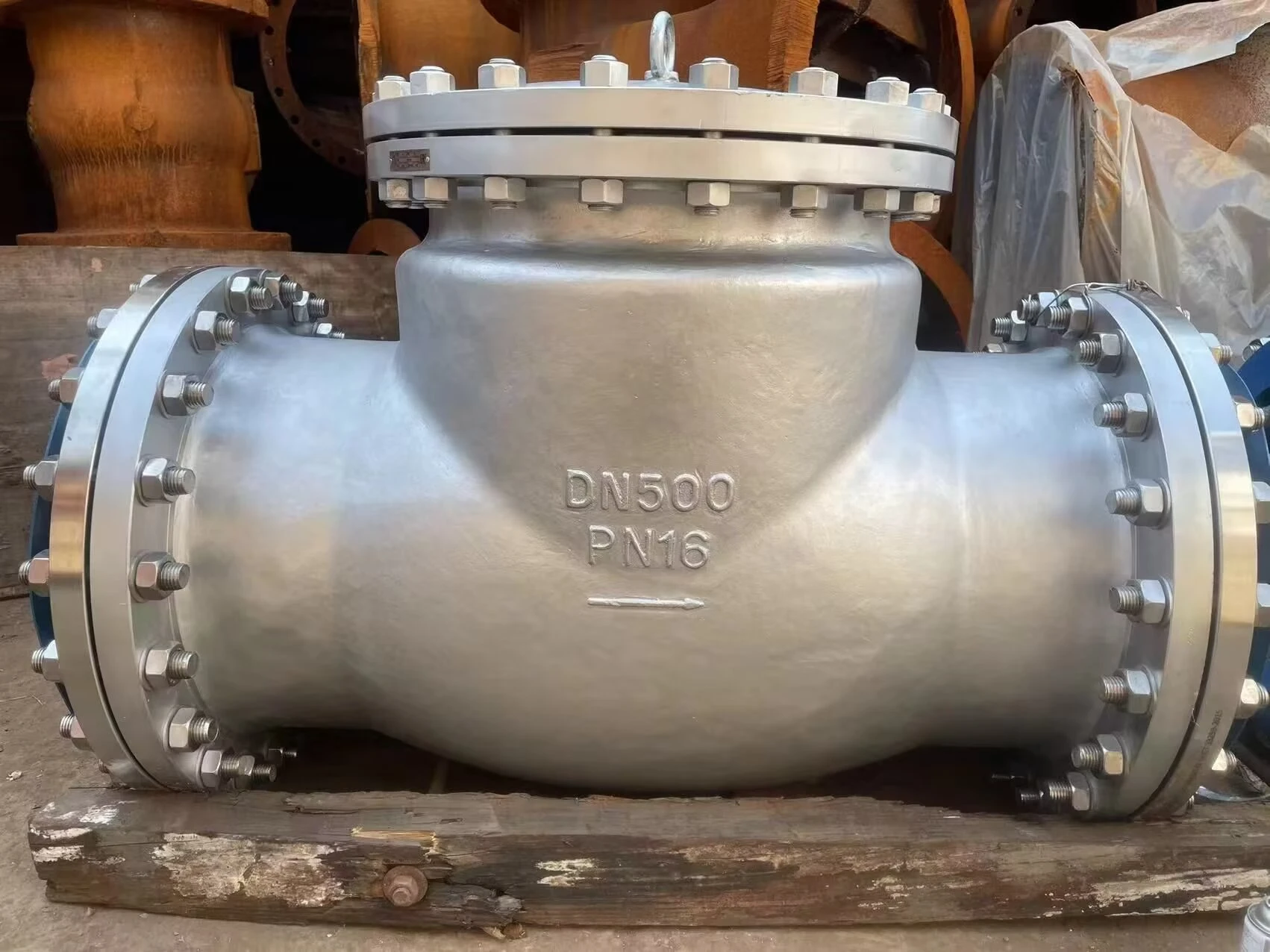
Performance & Engineering
Flanged check valves are engineered to minimize pressure drop while providing effective backflow prevention. Force analysis involves calculating the hydrodynamic forces acting on the disc during flow, and the spring forces (in spring-loaded designs) resisting opening. Environmental resistance is paramount, particularly concerning temperature extremes and corrosive media. The valve’s pressure-temperature rating, dictated by ASME B16.34, defines the maximum allowable working pressure at a given temperature. Compliance with industry standards, such as API 598 (valve inspection and testing), is essential. Functional implementation relies on the pressure differential across the valve: when upstream pressure exceeds downstream pressure, the disc opens, allowing flow; when the pressure equalizes or reverses, the disc closes under gravity or spring action, preventing backflow. Cavitation, a major concern in some applications, can damage the disc and valve body. Proper valve sizing and installation are crucial to mitigate cavitation risk. The crack opening area of the valve dictates its ability to handle solids and viscous fluids without clogging. Furthermore, fugitive emissions, especially with hazardous fluids, must be addressed through proper sealing materials and gland packing design, adhering to standards like EPA Method 21.
Technical Specifications
| Parameter | Unit | Typical Value (Carbon Steel) | Typical Value (316 Stainless Steel) |
|---|---|---|---|
| Maximum Working Pressure | psi | 2500 | 2000 |
| Temperature Range | °F | -20 to 450 | -328 to 650 |
| Connection Type | - | Flanged (ASME B16.5) | Flanged (ASME B16.5) |
| Body Material | - | ASTM A105 | ASTM A351 CF8M |
| Disc Material | - | Carbon Steel / PTFE | 316 Stainless Steel / PTFE |
| Cv (Flow Coefficient) | - | 5-500 (depending on size) | 5-500 (depending on size) |
Failure Mode & Maintenance
Common failure modes for flanged check valves include disc erosion due to abrasive fluids, seat damage leading to leakage, spring fatigue in spring-loaded designs, and corrosion of valve body materials. Fatigue cracking can occur in the disc or body under cyclic loading. Delamination of coatings (epoxy, galvanization) exposes the underlying metal to corrosion. Oxidation, particularly at high temperatures, can weaken the valve body. Proper maintenance is crucial for preventing these failures. This includes regular visual inspections for signs of corrosion, leakage, or damage. Periodic testing of seat leakage (using air or water) is recommended. Lubrication of moving parts (hinge, spring) reduces wear and tear. Disassembly and inspection of internal components should be performed on a scheduled basis, replacing worn or damaged parts. For valves exposed to corrosive environments, periodic coating repair or replacement may be necessary. Preventative maintenance programs, incorporating vibration analysis and thermal imaging, can identify potential failures before they occur. Documented maintenance records are essential for tracking valve performance and identifying recurring issues.
Industry FAQ
Q: What are the key differences between swing check valves and flanged check valves in terms of application suitability?
A: Swing check valves are generally suited for lower velocity applications where a more gradual closure is acceptable. Flanged check valves, due to their robust design and positive sealing, are preferred for higher velocity flows, high-pressure systems, and applications where rapid closure is critical to prevent water hammer or other pressure surges. The flanged connection also provides greater structural integrity for larger pipe sizes.
Q: How does material selection impact the lifespan of a flanged check valve in a corrosive environment?
A: Material selection is paramount. Carbon steel, without adequate protection, will quickly corrode in aggressive environments. Stainless steel (316 or Duplex) provides significantly better resistance, but even these alloys can be susceptible to specific types of corrosion (e.g., pitting, crevice corrosion). The correct elastomer selection for the seat (e.g., Viton, EPDM) is also critical to ensure compatibility with the fluid.
Q: What are the common causes of leakage in flanged check valves, and how can they be addressed?
A: Leakage often stems from seat damage (erosion, abrasion, or deformation), foreign object interference, or improper installation. Addressing this requires seat repair or replacement, removal of debris, and verification of proper flange bolting torque per ASME B16.5 standards. Regular inspections and preventative maintenance are crucial for early detection.
Q: What are the implications of exceeding the pressure-temperature rating of a flanged check valve?
A: Exceeding the pressure-temperature rating can lead to catastrophic failure, including body cracking, gasket blow-out, and potentially explosive rupture. It compromises the valve's structural integrity and poses a significant safety hazard. Valves must be selected and operated within their specified limits, as defined by ASME B16.34.
Q: How important is proper valve sizing in preventing cavitation and ensuring optimal performance?
A: Proper valve sizing is critical. Undersized valves create excessive velocity, increasing the risk of cavitation. Oversized valves reduce flow velocity and may not close effectively. Accurate flow rate calculations and consideration of fluid properties are essential for selecting the correct valve size, minimizing pressure drop, and preventing damage.
Conclusion
Flanged check valves represent a foundational technology in fluid handling systems, offering reliable backflow prevention in diverse industrial applications. Their performance hinges on precise material selection, robust manufacturing processes, and adherence to stringent industry standards. Understanding the potential failure modes and implementing comprehensive preventative maintenance programs are crucial for maximizing valve lifespan and ensuring system safety.
Future advancements in flanged check valve technology will likely focus on smart valve designs incorporating sensor technology for real-time monitoring of valve condition and performance. Materials research will continue to drive the development of more corrosion-resistant alloys and sealing materials. Optimized fluid dynamic designs will further minimize pressure drop and cavitation risk, enhancing overall system efficiency and reliability.
-
Top Reasons to Choose a Stainless Steel Flange Check Valve for Industrial Applications
-
Flanged Elbow Performance Analysis
-
3 bolt flange bearings Performance Analysis
-
elbow with flange Performance Analysis
-
Elbow Flanges Performance Analysis
-
flanged check valves Performance Analysis
-
Flange Square Performance Analysis
-
flanged butterfly valve Performance Analysis
-
flanged gate valve Material Science Manufacturing
-
Pinion Flange Performance Analysis
-
Precision flange Performance Analysis
-
Stub End Flange Performance Analysis
-
Turbo Exhaust Flange Material Analysis
-
Shaft collar flange Performance Analysis
-
butterfly valve flanged Performance Analysis
 Afrikaans
 Albanian
 Amharic
 Arabic
 Armenian
 Azerbaijani
 Basque
 Belarusian
 Bengali
 Bosnian
 Bulgarian
 Catalan
 Cebuano
 Corsican
 Croatian
 Czech
Czech
 Danish
 Dutch
Dutch
 Esperanto
 Estonian
 Finnish
 French
 Frisian
 Galician
 Georgian
 German
 Greek
Greek
 Gujarati
 Haitian Creole
 Hausa
Hawaiian
Hausa
Hawaiian
 Hebrew
 Hindi
Hindi
 Miao
Miao
 Hungarian
 Icelandic
 Igbo
Igbo
 Indonesian
 Irish
Irish
 Italian
 Japanese
 Javanese
Kannada
Javanese
Kannada
 Kazakh
 Khmer
Khmer
 Rwandese
 Korean
 Kurdish
 Kyrgyz
 Lao
Lao
 Latin
Latin
 Latvian
 Lithuanian
 Luxembourgish
 Macedonian
 Malgashi
 Malay
Malay
 Malayalam
 Maltese
 Maori
Maori
 Marathi
 Mongolian
 Myanmar
 Nepali
 Norwegian
 Norwegian
 Occitan
 Pashto
 Persian
 Polish
 Portuguese
Punjabi
Portuguese
Punjabi
 Romanian
 Russian
 Samoan
 Scottish Gaelic
 Serbian
 Sesotho
 Shona
Shona
 Sindhi
 Sinhala
 Slovak
 Slovenian
 Somali
 Spanish
 Sundanese
 Swahili
 Swedish
Tagalog
Swedish
Tagalog
 Tajik
Tajik
 Tamil
Tamil
 Tatar
Tatar
 Telugu
 Thai
Thai
 Turkish
 Turkmen
 Ukrainian
 Urdu
Urdu
 Uighur
 Uzbek
Uzbek
 Vietnamese
 Welsh
Welsh
 Bantu
Bantu
 Yiddish
 Yoruba
 Zulu
Zulu
 English